Down syndrome is a chromosome disorder caused by an extra chromosome 21 that results in intellectual disability and physical abnormalities.
Down syndrome is caused by an extra chromosome 21.
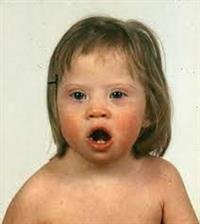
Children with Down syndrome have delayed physical and mental development, specific head and facial features, and are often short.
Before birth, Down syndrome may be suspected based on ultrasonography or tests on the mother''''s blood and confirmed using chorionic villus sampling and/or amniocentesis.
After birth, the diagnosis is suggested by the child’s physical appearance and is confirmed by finding an extra chromosome 21, usually by testing a blood sample.
There is no cure for Down syndrome, but some specific symptoms and problems caused by the syndrome can be treated.
Most children with Down syndrome survive to adulthood.
Chromosomes are structures within cells that contain DNA and many genes. Genes are segments of deoxyribonucleic acid (DNA) and contain the code for a specific protein that functions in one or more types of cells in the body. Genes contain instructions that determine how the body is supposed to look and function. (See Genes and Chromosomes for a discussion about genetics.)
An extra chromosome, making three of the same chromosome (instead of the normal two), is called trisomy.
The most common trisomy in a newborn is trisomy 21 (an extra chromosome 21, which is the smallest human chromosome). It is possible for an embryo to have trisomy of any chromosome however, an extra of one of the larger chromosomes is more likely to end in miscarriage or stillbirth.
Trisomy 21 causes about 95% of the cases of Down syndrome. Thus, most people with Down syndrome have 47 chromosomes instead of the normal 46. However, about 4% of people with Down syndrome have 46 chromosomes, but the extra chromosome 21 is attached to another chromosome, creating an abnormal, but not extra, chromosome. This abnormal attachment is called translocation