
Prostatectomy is a surgical procedure to remove the prostate gland and the cancer in it, The surrounding seminal vesicles are usually removed as well. Not every patient with prostate cancer can benefit from a prostatectomy. This procedure is used only if the cancer has not extended outside the prostate and into the pelvis or abdomen.
A prostatectomy is always done under general anesthesia, and may be performed by
A vertical incision in the lower abdomen
An incision between the scrotum and the rectum
Many small incisions in the abdomen to allow for a laparoscopic prostatectomy
Many small incisions and then with the help of a robot known as the Da Vinci robotic system.
The prostatectomy can also be done in a manner that tries to save the nerves that surround the prostate. A variation of the operation involves nerve grafting. The surgeon reconnects the nerves that have been cut with a nerve taken either from the leg or from inside the pelvis. In all types of surgery, once the prostate is removed the surgeon reconnects the neck of the bladder to the urethra with very delicate sutures.
INTRODUCTION
Prostate cancer is a very common condition that affects men. The rate of occurrence of prostate cancer increases with age.
Prostatectomy is a surgery that removes the prostate gland and the cancer in it. Not every patient with prostate cancer can benefit from a prostatectomy.
This patient education tutorial explains the most common ways the prostate is surgically removed. It details what to expect from the surgery, as well as the possible risks and complications.
ANATOMY
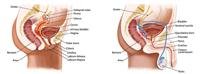
The human body has two kidneys. The kidneys continuously filter the blood and make urine. The urine flows to the bladder through two specialized tubes called ureters. Urine is stored in the bladder until urination occurs.
A specialized muscle, known as the “internal sphincter,” at the outlet, or neck, of the bladder, prevents the urine from dripping out all the time. When the bladder is full, you feel an urge to urinate.
When we urinate we cause our bladder to contract and the sphincter to relax. This allows the urine to pass to the outside through the urethra, located inside the penis.
The penis is also used for reproduction. The sperm is made in the two testicles located in the scrotum. From there, the sperm travels to the prostate through the two specialized tubes called “vasa deferentia.”
The sperm is mixed with a special secretion from the prostate and the two seminal vesicles, which are located near the outlet of the bladder.
The seminal vesicles are two glands that sit near the top of the prostate.
The prostate is a walnut size gland that surrounds the urethra and sits just below the bladder. The urethra passes through the prostate on its way to the penis.
Small nerves responsible for erection pass very close to the prostate.
The combination of sperm from the testicles and the secretions from the prostate and seminal vesicles is called semen. It is stored in the seminal vesicles. During ejaculation, the semen is forced out of the penis through the urethra.
The "internal sphincter" of the bladder prevents the semen from going back into the bladder.
The urethra runs through the penis and opens at its tip. Two other structures, known as “corpora cavernosa,” run alongside the urethra. With stimulation, the structures fill up with blood, causing the penis to become erect.
The penis has different nerves that control erection. Some of these nerves send messages to the brain, telling it that the genitalia are being stimulated. This causes partial arousal.
Other nerves from the brain and spinal cord, known as “parasympathetic” nerves, cause the corpora cavernosa to fill with blood, resulting in erection of the penis.
Other nerves known as “sympathetic” nerves control ejaculation.
PROSTATE CANCER
Prostate cancer affects 1 in every 6 men. 234,000 new cases of prostate cancer are diagnosed every year in the United States. The rate of occurrence of prostate cancer increases with age.
A blood test known as PSA, or Prostate Specific Antigen, helps detect prostate cancer early. This test is usually done once a year depending on your age.
Once your doctor has a strong suspicion that you may have prostate cancer, he or she will refer you to a urologist. A urologist is a doctor that specializes in the urinary tract system. The urologist will probably do a biopsy of the prostate to determine whether you have prostate cancer.
During a biopsy, the doctor takes a sample of tissue from the prostate and sends it to the lab to be analyzed under a microscope. The doctor who examines the biopsied tissue is called a pathologist.
If prostate cancer is discovered, more tests will be done to see if the cancer is limited to the prostate, or if it has spread beyond the prostate into the pelvis, abdomen, or the rest of the body. The spread of cancer is known as metastasis. The process to determine if and where the cancer has spread is known as staging.
Usually, when prostate cancer spreads, it involves lymph nodes in the pelvis or abdomen.
Because prostate cancer may involve many parts of the prostate, surgery aims at removing the entire prostate gland, usually with the surrounding seminal vesicles.
This is only done if the cancer has not extended outside the prostate and into the pelvis or abdomen. This type of surgery is known as a prostatectomy.
OTHER TREATMENTS
Surgery is one of many options available to treat prostate cancer. Other treatments of prostate cancer include:
Radiation therapy, either with an external machine or with seeds placed in the prostate
Cryotherapy: the use of a cold substance that kills cancer cells by freezing them
Hormonal therapy, which uses hormones to suppress the cancer cells
Castration or orchiectomy: the removal of the testicle to lower the levels of testosterone, which is another form of hormonal therapy
High intensity ultrasounds that aim at burning the cancer cells
Because of the variety of possible treatments, it is extremely important to discuss all of your options with your urologist, radiation therapist, or oncologist.
PROCEDURE
There are many ways of doing a prostatectomy. The exact procedure that you will undergo depends on your specific condition, and your urologist’s preference and experience. The aim of all of these operations is to remove the prostate gland in its entirety. In most cases, the seminal vesicles are removed as well.
Prostatectomy is done under general anesthesia. The prostate can be removed through any of the following:
A vertical incision in the lower abdomen. This is known as a radical retropubic prostatectomy because the tumor is taken from behind the pubic bone from the front of the pelvis. Radical means that the whole prostate is removed.
An incision between the scrotum and the rectum. This is known as a radical perineal prostatectomy.
Many small incisions in the abdomen with the use of scopes. This is known as a laparoscopic prostatectomy.
Many small incisions with the help of a robot known as the Da Vinci Robotic system. This is similar to a laparoscopic prostatectomy, but it is done with the use of a robot manipulated by a urologist.
The prostatectomy can also be done in a way that tries to save the nerves that surround the prostate; this is known as nerve-sparing prostatectomy. Such a prostatectomy may have better chances at maintaining erectile function. This can only be done if the cancer has not reached the outside of the prostate.
One last variation of the operation is known as nerve grafting. The surgeon, after cutting the nerves that surround the prostate, reconnects them using a nerve taken either from the leg or from inside the pelvis. This operation is also more involved than the usual prostate operations. It takes longer to perform and may require another incision in the lower leg to find the nerve. The nerve taken from the leg does not control any muscles; it just carries sensation from the outer part of the foot. The nerve taken from inside the pelvis carries sensation to the inner thigh.
Prior to removing the prostate, the surgeon may take out some lymph nodes from the pelvis or abdomen. A pathologist checks these at the time of the operation. If any cancer is found in the nodes, the prostatectomy may be cancelled, because it would mean the cancer has spread beyond the prostate.
No matter what approach is taken for the prostatectomy, once the prostate is removed, the urethra that runs through it is cut.
After removing the prostate, the surgeon reconnects the neck of the bladder to the urethra with very delicate sutures.
In the case of a nerve grafting operation, the nerves around the prostate are reconnected with the nerve taken from the leg, and the incisions are closed.
When the patient wakes up he will have a catheter in his bladder. The catheter is a tube that goes through the penis to the bladder and is called a Foley® catheter. The Foley catheter protects the sutures that are placed in the urethra. Ten days to two weeks after the operation, when the surgeon feels that the urethra is well healed, the catheter is taken out. This is usually done in the urologist’s office.
The patient may stay in the hospital for a few days.
It is normal after the operation to have blood in the urine. This should clear as time passes.
RISKS AND COMPLICATIONS
Prostatectomy is safe. There are, however, several possible risks and complications. These are unlikely, but possible. You need to know about them just in case they happen. By being informed you may be able to help your doctor detect complications early.
The risks and complications include those related to anesthesia and those related to any type of surgery.
Risks of general anesthesia include nausea, vomiting, urinary retention, cut lips, chipped teeth, sore throat, and headache. More serious risks of general anesthesia include heart attack, stroke, and pneumonia.
Your anesthesiologist will discuss these risks with you, and ask you if you are allergic to certain medications.
Blood clots in the legs can occur due to inactivity during and after the surgery. These usually show up a few days after surgery. They cause the leg to swell and hurt.
Blood clots can become dislodged from the leg and go to the lungs, where they will cause shortness of breath, chest pain, and possibly death. It is very important to let your doctors know if any of these symptoms occur. Sometimes the shortness of breath can happen without warning. If you are able to get out of bed and move around after surgery, doing so may help decrease the risk of blood clots in the legs.
Some of the risks are seen in any type of surgery. These include
Infections involving the bladder, the pelvis, or the abdomen. Treating these infections may require long-term antibiotics, and possibly catheter placement, and surgery.
Bleeding, either during or after the operation. In the case of significant bleeding, you may require a blood transfusion. The catheter may need to remain in your bladder for a longer time. Removal of blood clots from the bladder may also become necessary under general or spinal anesthesia.
Scars that can be painful as well as scars inside the urethra that could cause further urination problems.
Other risks and complications are related specifically to these procedures. These are also unlikely. However, it is important to know about them.
During the surgery, any nearby pelvic or abdominal organs can be injured, including the bladder, rectum, colon, intestines, arteries, veins, and nerves.
These injuries may require other surgeries to repair the injured organs. Death is extremely rare, but possible.
Another risk of this operation is erectile dysfunction. Most men who undergo this operation will have problems with erection and may also become impotent. As time passes, though, the erectile dysfunction may improve, especially in men who undergo nerve-sparing operation. It may take up to two years to know whether erectile functioning will recover.
Some patients may have problems with erectile dysfunction before this operation. The erectile function will not be better than what it was before the operation.
Fortunately, there are many medical and surgical methods to improve erectile function, including medications such as Viagra®. Your urologist will discuss these options with you.
Because most of the ejaculate is made from the prostate and seminal vesicle secretions, this operation will result in complete absence of ejaculation, even when erectile function is recovered.
This, however, does not change the sensation or the feeling of an orgasm. This type of orgasm is known as a ‘dry orgasm.’
The lack of ejaculation means that the patient will not be able to father a child after the operation. Even though this may not be a problem for older men, younger men who are still interested in having children may want to ‘bank’ sperm before the operation. This ‘banked sperm’ can then be used for artificial insemination at a later date.
Even though this operation will result in the man’s inability to have children, it does NOT protect against sexually transmitted diseases. Therefore, safe sex practices should still be used.
Most patients will also initially have problems retaining their urine, resulting in leaking and the necessity of using pads. This is known as urinary incontinence.
A majority of patients will recover adequate urinary control over time.
Medications and surgical procedures are available to help recover urinary continence.
Patients who have the nerve-grafting operation may have another incision to get a nerve. This incision may be in their leg near their outer ankle. Removing this small nerve will cause the outer part of the foot to become numb forever. It does not cause any weakness in the foot, though. Risks of this part of the operation include, but are not limited to, bleeding, infection, and, in extremely rare cases, paralysis. When the nerve is taken from inside the pelvis then the patient may have numbness on the inner side of the thigh.
If the prostatectomy is laparoscopic, the surgeon may decide during surgery to change the operation from a laparoscopic procedure to an open procedure if he or she feels it is safer to do so.
AFTER SURGERY
Immediately after the operation, you will be taken to a recovery room, where you will be allowed to wake up from the anesthesia. Then you will be taken to a regular hospital bed and will spend a few days in the hospital.
Patients who have had the laparoscopic or robot-assisted operations tend to have less blood loss and a faster recovery.
You will have a catheter in your bladder for up to two weeks. A catheter in the bladder may give you the constant feeling of having to urinate; this is normal.
Some blood in the urine is also normal for a few days following the surgery.
You and/or your family members will be instructed on how to empty the catheter safely and cleanly.
You will also be encouraged to walk as much as possible after the surgery. This will help prevent blood clots from developing in the legs.
You will be instructed on how to take care of your incision. Depending on how your incision is closed, you may either be allowed to wet it or not. Check with your nurse about the possibility of showering after the operation, and whether or not you have to cover the incision. Remember that depending on the prostatectomy technique that your doctor recommends, you may have more than one incision.
Sutures or staples usually need to be removed in about 7 to 10 days. This is usually done in your doctor’s office. Some incisions are closed with absorbable sutures that will dissolve on their own. Special skin glue can also be used, which peels off in about 10 days.
Some redness around the incision is normal. However, a lot of redness, pain, tenderness, and any kind of drainage needs to be reported to your surgeon.
You will be asked to refrain from doing any heavy lifting, bending, or twisting. And you should not work until after your follow-up appointment.
Some blood in the urine may be normal early on, but if the urine becomes cloudy, or has a very foul smell, you may have a urine-tract infection, and you should tell your surgeon.
Any leg swelling or pain may be a sign of blood clots in the legs. You should inform your doctor of such symptoms as soon as possible.
Before you come for your follow-up appointment, make sure to write down all of the questions you wish to ask your doctor so you don’t forget them.
Remember there are NO stupid questions.
Questions you may want to ask are
What should I look for from here on?
What is the next step?
What can I do? How much lifting can I do?
When can I go back to work?
How should I manage my urinary incontinence?
When should I start worrying about my erectile function, and what can I do for it?
CONCLUSION
Prostate cancer is very common. Surgery is one way of dealing with this cancer. A prostatectomy is a serious, but safe operation.
Its success in curing prostate cancer depends on the stage of the cancer. The earlier the cancer is discovered, the easier it is to eradicate it.
Prostatectomy has certain risks and complications. Knowing about them may help you detect them early if they happen.