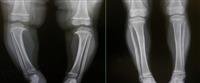
Orthopedics is a branch of surgery Specializes in correcting bone and joint deformities, treating their diseases, and preventing these deformities in the future. And its specialists are called Orthopedic surgeons.
What does orthopedic surgery include?
Correcting congenital deformities in children''s bones.
Treatment of chronic arthritis, fractures and dislocations.
Treatment for joint and bone tumors.
Bone implantation.
Installing prostheses.
It also includes orthotics The use of physical therapy, and the use of medical shoes.
The importance of orthopedics
Orthopedic surgery is concerned with modifying, straightening, or repairing deformities in the bones, and these deformities some of them result from factors that may affect the body while it is still in the fetal stage, and most of them are apparent at birth, and others result from injuries or acquired diseases that affect the body.
Among the important deformities that fall within the scope of orthopedic surgery
Posterior dislocation of the thigh joint.
Scoliosis.
The feet are cleansed.
Malformations caused by polio.
Birth injuries.
Deformities resulting from acute or chronic infections of the bones and joints, such as joint tuberculosis and others.
As well as cases resulting from poor treatment of some bone and joint injuries, such as dislocations and fractures, and it is used to correct these deformities, or to treat them.
The evolution of orthopedic surgery
Many methods include treatment by hand and sports movements, the use of special devices for the limbs or the trunk, and the conduct of many delicate surgeries on bones, joints and tendons, and possibly nerves and skin.
Accident and fracture surgery almost separated from surgery and medicine with the presence of orthopedic specialization that does not practice medicine, but only orthopedics of bone fractures. Since the beginning of the development of Arab medicine, the Arabs have separated between general surgery and orthopedics, so splinting fractures is part of surgery, but it is one of the first branches of specialization in surgery and he excelled in it Arab doctors expanded their research and treated all types of fractures in small and large bones.
The development in life sciences has led to the development of methods of surgery and orthopedics in particular, as the splinting of fractures has evolved from the use of simple casts to the use of gypsum and then metal rods, especially from minerals that do not harm the body, to the discovery of many new diseases by available research methods and follow-up of patients from By professionals in this field.
Orthopedic surgery is performed on any part of the skeleton, including
Shoulder and elbow.
knee.
Foot and ankle.
Hand and forearm.
the pelvis.
Backbones.
Orthopedic injuries resulting from accidents.
Diseases affecting the musculoskeletal system and repairing ligaments and tendons.
Arthritis.
Bone tumors.
Inflammation of the bones and their nerves.
Restoration, splinting and endoscopy.
Orthopedic surgery is not limited to treating and repairing the affected person, but rather includes replacing them with metal joints and bones, such as knee replacement and pelvic replacement, and in some cases, claudication problems may be surgically repaired to avoid joint deformity and damage to the healthy leg.
There are other operations within orthopedics with unsatisfactory motives, such as the Ilizarov operation, which increases the height of people of short stature by an average of 15-25 cm.