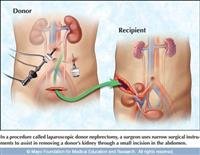
Chronic kidney disease is a major health concern in this country afflicting more than eight million Americans. When kidney function declines to a certain level, patients have end-stage renal disease and require either dialysis or transplantation to sustain their life. Currently more than 340,000 people are on dialysis, with 106,000 new patients added in 2006. Over 140,000 people are living with a functioning kidney transplant (source: www.usrdsrg). The prevalence of these two populations of end-stage renal disease has tripled in the last 20 years. Medicare expenditure for end-stage renal disease is expected to exceed $28 billion in 2010.
In 2006, 10,659 patients received a deceased donor kidney transplant and 6,432 patients received a live donor kidney transplant. However, more than 74,000 people are currently on the national waiting list for a deceased donor kidney transplant (source: www.usrds.org). Despite the increasing numbers of kidney transplants performed each year, the waiting list continues to grow. Twelve people die each day awaiting a kidney transplant.
Normal Kidney Function
The kidneys are organs whose function is essential to maintain life. Most people are born with two kidneys, located on either side of the spine, behind the abdominal organs and below the rib cage. The kidneys perform several major functions to keep the body healthy.
Filtration of the blood to remove waste products from normal body functions, passing the waste from the body as urine, and returning water and chemicals back to the body as necessary.
Regulation of the blood pressure by releasing several hormones.
Stimulation of production of red blood cells by releasing the hormone erythropoietin.
The normal anatomy of the kidneys involves two kidney bean shaped organs that produce urine. Urine is then carried to the bladder by way of the ureters. The bladder serves as a storehouse for the urine. When the body senses that the bladder is full, the urine is excreted from the bladder through the urethra.
Kidney Disease
When the kidneys stop working, renal failure occurs. If this renal failure continues (chronically), end-stage renal disease results, with accumulation of toxic waste products in the body. In this case, either dialysis or transplantation is required.
Common Causes of End-Stage Renal Disease
Diabetes mellitus
High blood pressure
Glomerulonephritis
Polycystic Kidney Disease
Severe anatomical problems of the urinary tract
Treatments for End-stage Renal Disease
The treatments for end-stage renal disease are hemodialysis, a mechanical process of cleaning the blood of waste products peritoneal dialysis, in which waste products are removed by passing chemical solutions through the abdominal cavity and kidney transplantation.
However, while none of these treatments cure end-stage renal disease, a transplant offers the closest thing to a normal life because the transplanted kidney can replace the failed kidneys. However, it also involves a life-long dependence on drugs to keep the new kidney healthy. Some of these drugs can have severe side effects.
Some kidney patients consider a transplant after beginning dialysis others consider it before starting dialysis. In some circumstances, dialysis patients who also have severe medical problems such as cancer or active infections may not be suitable candidates for a kidney transplant.
Kidney Transplantation
Kidneys for transplantation come from two different sources: a living donor or a deceased donor.
The Living Donor
Sometimes family members, including brothers, sisters, parents, children (18 years or older), uncles, aunts, cousins, or a spouse or close friend may wish to donate a kidney. That person is called a "living donor." The donor must be in excellent health, well informed about transplantation, and able to give informed consent. Any healthy person can donate a kidney safely.
Deceased Donor
A deceased donor kidney comes from a person who has suffered brain death. The Uniform Anatomical Gift Act allows everyone to consent to organ donation for transplantation at the time of death and allows families to provide such permission as well. After permission for donation is granted, the kidneys are removed and stored until a recipient has been ed.
Transplant Evaluation Process
Regardless of the type of kidney transplant-living donor or deceased donor-special blood tests are needed to find out what type of blood and tissue is present. These test results help to match a donor kidney to the recipient.
Blood Type Testing
The first test establishes the blood type. There are four blood types: A, B, AB, and O. Everyone fits into one of these inherited groups. The recipient and donor should have either the same blood type or compatible ones, unless they are participating in a special program that allow donation across blood types. The list below shows compatible types:
If the recipient blood type is A Donor blood type must be A or O
If the recipient blood type is B Donor blood type must be B or O
If the recipient blood type is O Donor blood type must be O
If the recipient blood type is AB Donor blood type can be A, B, AB, or O
The AB blood type is the easiest to match because that individual accepts all other blood types.
Blood type O is the hardest to match. Although people with blood type O can donate to all types, they can only receive kidneys from blood type O donors. For example, if a patient with blood type O received a kidney from a donor with blood type A, the body would recognize the donor kidney as foreign and destroy it.
Tissue Typing
The second test, which is a blood test for human leukocyte antigens (HLA), is called tissue typing. Antigens are markers found on many cells of the body that distinguish each individual as unique. These markers are inherited from the parents. Both recipients and any potential donors have tissue typing performed during the evaluation process.
To receive a kidney where recipient''s markers and the donor''s markers all are the same is a "perfect match" kidney. Perfect match transplants have the best chance of working for many years. Most perfect match kidney transplants come from siblings.
Although tissue typing is done despite partial or absent HLA match with some degree of "mismatch" between the recipient and donor.
Crossmatch
Throughout life, the body makes substances called antibodies that act to destroy foreign materials. Individuals may make antibodies each time there is an infection, with pregnancy, have a blood transfusion, or undergo a kidney transplant. If there are antibodies to the donor kidney, the body may destroy the kidney. For this reason, when a donor kidney is available, a test called a crossmatch is done to ensure the recipient does not have pre-formed antibodies to the donor .
The crossmatch is done by mixing the recipient''s blood with cells from the donor. If the crossmatch is positive, it means that there are antibodies against the donor. The recipient should not receive this particular kidney unless a special treatment is done before transplantation to reduce the antibody levels. If the crossmatch is negative, it means the recipient does not have antibodies to the donor and that they are eligible to receive this kidney.
Crossmatches are performed several times during preparation for a living donor transplant, and a final crossmatch is performed within 48 hours before this type of transplant.
Serology
Testing is also done for viruses, such as HIV (human immunodeficiency virus), hepatitis, and CMV (cytomegalovirus) to the proper preventive medications after transplant. These viruses are checked in any potential donor to help prevent spreading disease to the recipient.
Phases of Transplant
Pre-transplant Period
This period refers to the time that a patient is on the deceased donor waiting list or prior to the completion of the evaluation of a potential living donor. The recipient undergoes testing to ensure the safety of the operation and the ability to tolerate the anti-rejection medication necessary after transplantation. The type of tests varies by age, gender, cause of renal disease, and other concomitant medical conditions. These may include, but are not limited to:
General Health Maintenance: general metabolic laboratory tests, coagulation studies, complete blood count, colonoscopy, pap smear and mammogram (women) and prostate (men)
Cardiovascular Evaluation: electrocardiogram, stress test, echocardiogram, cardiac catheterization
Pulmonary Evaluation: chest x-ray, spirometry
Potential Reasons of Excluding Transplant Recipient
Uncorrectable cardiovascular disease
History of metastatic cancer or ongoing chemotherapy
Active systemic infections
Uncontrollable psychiatric illness
Current substance abuse
Current neurological impairment with significant cognitive impairment and no surrogate decision maker
Transplant Surgery
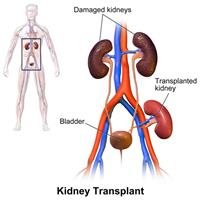
The transplant surgery is performed under general anesthesia. The operation usually takes 2-4 hours. This type of operation is a heterotopic transplant meaning the kidney is placed in a different location than the existing kidneys. (Liver and heart transplants are orthotopic transplants, in which the diseased organ is removed and the transplanted organ is placed in the same location.) The kidney transplant is placed in the front (anterior) part of the lower abdomen, in the pelvis.
The original kidneys are not usually removed unless they are causing severe problems such as uncontrollable high blood pressure, frequent kidney infections, or are greatly enlarged. The artery that carries blood to the kidney and the vein that carries blood away is surgically connected to the artery and vein already existing in the pelvis of the recipient. The ureter, or tube, that carries urine from the kidney is connected to the bladder. Recovery in the hospital is usually 3-7 days.
Complications can occur with any surgery. The following complications do not occur often but can include:
Bleeding, infection, or wound healing problems.
Difficulty with blood circulation to the kidney or problem with flow of urine from the kidney.
Post Transplant Period
The post transplant period requires close monitoring of the kidney function, early signs of rejection, adjustments of the various medications, and vigilance for the increased incidence of immunosuppression-related effects such as infections and cancer.
Just as the body fights off bacteria and viruses (germs) that cause illness, it also can fight off the transplanted organ because it is a "foreign object." When the body fights off the transplanted kidney, rejection occurs.
Rejection is an expected side effect of transplantation and up to 30% of people who receive a kidney transplant will experience some degree of rejection. Most rejections occur within six months after transplantation, but can occur at any time, even years later. Prompt treatment can reverse the rejection in most cases.
Anti-Rejection Medications
Anti-rejection medications, also known as immunosuppressive agents, help to prevent and treat rejection. They are necessary for the "lifetime" of the transplant. If these medications are stopped, rejection may occur and the kidney transplant will fail.
Below is a list of medications that might be used after a kidney transplant. A combination of these drugs will be prescribed dependent on the specific transplant needs.
Anti-inflammatory Medication
Prednisone is taken orally or intravenously. Most side effects of prednisone are related to drug dosage levels. Prednisone is used at low dosages to minimize side effects. The possible side effects of prednisone are:
Changes in physical appearance such as puffiness of the face and weight gain.
Irritation to the stomach lining.
Increased risk of bruising and decreased rate of healing.
Increased sugar level in the