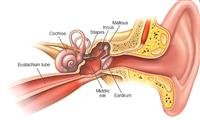

The auditory nerve transfers the acoustic waves of the brain until the speech is understood, so what are the methods used in the treatment of weakening of the auditory nerve
Each case is different from the other in the way of treating the weakness of the auditory nerve, but the hearing specialist may have to try all the solutions available before taking the best solution for the patient, and we provide you with ways to treat the weakness of the auditory nerve in the following lines:
Treatment of auditory nerve weakness: frequency modification systems
They are wireless audio devices that enlarge the sound from its source and transfer it to the individual while reducing the rear sounds and focusing on the sound to be heard by using radio waves that work to adjust the frequency and transfer the sound while maintaining the clarity and quality of the transferred sound.
The frequency modification system consists of two main devices: a transmitter and a reception device where the transmission device works to receive the sound from its source and transfer it to the reception device.
Although the frequency modification systems are flexible and easy to move, it is possible to have the lack of induction systems or sound induction episodes that are used to send and receive communication signals in most public places, so a person may have difficulty contacting others.
Treatment of auditory nerve weakness: auditory devices
Hearing Aids is one of the most important auditory devices used to treat auditory nerve weakness.
The auditory aids transfer sounds from the external environment to the ear, as most auditory aids are digital, meaning that it contains a slice equipped with an amplifier.
The chip works to convert the sound from sound waves into a digital code and then set the sound based on hearing impairment for each case and then the average digital code is converted into sound waves that reach the ears through loudspeakers. The auditory aids also contain batteries that are changed periodically or midwife batteries To recharge.
There are types of auditory aids in the treatment of auditory nerve weakness, the most prominent of which are:
1. Cic-Completely in the Canal
This type of auditory aids improves hearing in adults from light to medium and is inside the auditory canal in the entire ear, which is the smaller and less clear type, as it uses batteries of relatively short life in addition to being vulnerable to blockage with earwax.
2. The auditory assistants within the ear canal (ITC-in The Canal)
It is partially inside the auditory canal in the ear and may improve auditory performance from mild to medium in adults.
This type is less clear than large auditors and is difficult to adjust to its small size and also vulnerable to blockage with earwax.
3. ITE-In The Ear
It is used for people with severe to severe hearing impairment and this type is characterized by its microphone that improves the quality of the sound in noise, meaning it is more clear than small devices in addition to the long battery life that may be rechargeable.
4. Auditory behind the ear (BTE-Behind the Ear)
It is fixed behind the ear and this type is suitable for all ages and for all the reasons for hearing impairment.
It is used in the treatment of auditory nerve weakness because it is able to amplify almost all sounds and it also contains directional microphones in addition to that it may be available with a rechargeable battery.
The treatment of auditory nerve: surgery
The hearing nerve impaired can be treated by Cochlear Implant, which is the last solution to which the specialized hearing doctor resorted to after trying the earphones as it does not treat hearing loss, but it prevents the development of hearing impairment of worse.
The industrial cochlea is a complex electronic device that may help in amplify the sound for those who suffer from hearing impairment. The industrial cochlea consists of the following parts:
External part is behind the ear.
An internal part is surgically placed inside the ear.
Microphone picks up sounds from the external environment.
A processor for the sounds caught and arranged by the microphone.
A transmission and reception device receives signals from the processor and converts them into electrical impulses.
A group of electric electric poles and send them to the auditory nerve.
Motivates or stimulants of the auditory nerve.
The cultivation of industrial cochlea may enter into the treatment of auditory nerve weakness or hearing loss, as it enlarges sounds by stimulating the auditory nerve, which in turn transmits the issued sounds and sends it in the form of signals to the brain, which recognizes the signals sent as understandable sounds.
Nevertheless, people may take time from one case to another in learning or re -learning it.