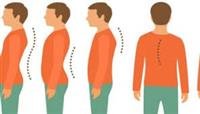
The spine, or backbone, is made up of small bones (vertebrae) stacked -- along with discs -- one on top of another. A healthy spine when viewed from the side has gentle curves to it. The curves help the spine absorb stress from body movement and gravity.
When viewed from the back, the spine should run straight down the middle of the back. When abnormalities of the spine occur, the natural curvaturs of the spine are misaligned or exaggerated in certain areas, as occurs with lordosis, kyphosis, and scoliosis.
What are the types of spine curvature disorders?
There are three main types of spine curvature disorders, including
Lordosis. Also called swayback, the spine of a person with lordosis curves significantly inward at the lower back.
Kyphosis. Kyphosis is characterized by an abnormally rounded upper back (more than 50 degrees of curvature).
Scoliosis. A person with scoliosis has a sideways curve to their spine. The curve is often S-shaped or C-shaped.
What causes spine curvature disorders?
There are a number of health problems that may cause the spine to curve more than normal or be misaligned.
The following conditions can cause lordosis
Achon lasia. A disorder in which bones do not grow normally, resulting in the short stature associated with dwarfism
Spondylolisthesis. A condition in which a vertebrae, usually in the lower back, slips forward
Osteoporosis, a condition in which vertebrae become fragile and can be easily broken (compression fractures)
Obesity, or being extremely overweight
Kyphosis. A condition marked by an abnormally rounded upper back
Discitis. Inflammation of the disc space between the bones of the spine most often caused by infection
Benign (harmless) juvenile lordosis
The following conditions can cause kyphosis
Abnormal vertebrae development in utero (congenital kyphosis)
Poor posture or slouching (postural kyphosis)
Scheuermann's disease, a condition that causes vertebrae to be misshaped (Scheuermann's kyphosis)
Arthritis
Osteoporosis
Spina bifida, a birth defect in which the spinal column of the fetus does not close completely during development inside the womb
Spine infections
Spine tumors
Doctors do not know what causes the most common type of scoliosis seen in adolescents. However, doctors do know that scoliosis tends to run in families. A disease, injury, infection, or birth defect also may be to blame.
What are the symptoms of spine curvature disorders?
Symptoms vary depending on the type of spine curvature disorder and the severity of the condition.
Symptoms of lordosis may include
Appearing swayback, with the buttocks being more pronounced
Having a large gap between the lower back and the floor when lying on your back on a hard surface that does not change when you bend forward
Back pain and discomfort
Problems moving certain ways
Symptoms of kyphosis are usually visible in nature and include
Bending forward of the head compared to the rest of the body
Hump or curve to the upper back
Fatigue in back or legs
Postural kyphosis does not typically cause back pain; however, physical activity and long periods of standing and sitting can cause discomfort for people with Scheuermann's kyphosis.
Symptoms of scoliosis may include having
Uneven shoulder blades with one being higher than the other
An uneven waist or hip
Leaning toward one side
How are spine curvature disorders treated?
In general, treatment is determined based on the severity and type of spinal curvature disorder you have. Mild spinal curvature, as occurs with postural kyphosis, may not be treated at all. More severe spinal curvature may require the use of a back brace or surgery.
Treatment for lordosis may include
Medication to relieve pain and swelling
Exercise and physical therapy to increase muscle strength and flexibility
Wearing a back brace
Weight loss
Surgery
Treatment for kyphosis may inclu
Exercise and anti-inflammatory medication to ease pain or discomfort
Wearing a back brace
Surgery to correct severe spine curvature and congenital kyphosis
Exercises and physical therapy to increase muscle strength
Treatment for scoliosis may include
Observation. If there is a slight curve your doctor may choose to check your back every four to six months to see if the curve gets worse.
Bracing. Depending on the degree of the curve, a back brace is sometimes prescribed for kids and adolescents who are still growing. Bracing can help prevent the curve from getting worse.
Surgery. If the curve is severe and is getting worse, surgery is sometimes needed.
Body casting. A cast is placed from the shoulders to the lower trunk while the child is under anesthesia. It is replaced every few months for up to 3 years. This is usually reserved for young children when a scoliosis curve looks like it will get worse as they grow.
Exercise programs, chiropractic treatment, electrical stimulation, and nutritional supplements have not been proven to prevent the worsening of scoliosis. It is still ideal to keep as much as strength and flexibility to maintain normal function. This may require more effort and attention in someone with scoliosis.
What types of surgery are used to treat spine curvature disorders?
The following procedures may be used to treat spine curvature disorders
Spinal instrumentation. Instruments such as hooks, rods, and wire are attached to the spine to realign the bones of the spine and keep them secure following spinal fusion.
Artificial disc replacement. Degenerated discs in the spine are replaced with artificial devices.
Kyphoplasty. A balloon is ed inside the spine to straighten and stabilize the affected area and relieve pain.
How do I know if I have a spine curvature disorder?
Your doctor can diagnose a spine curvature disorder by taking a medical and family history, examining the curve of your spine during a physical examination, and using imaging tests, like X-rays, to look more closely at the spine. X-rays can show if there are any abnormalities to the bones of the spine and can also measure how much curve is present.
If you or a loved one's back appears to have an abnormal curve to it, beyond just poor posture, see your doctor so that you can be evaluated and treated.