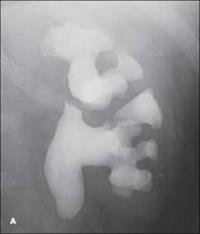
Urinary system stones are widespread in the Kingdom of Saudi Arabia for several reasons, including: genetic, genetic, and climatic, and it has a relationship with the quality of food and water consumed.
Methods of treatment for it
First, through drug therapy.
Most stones form in an acid urine medium, and in this case it is preferable to use drugs that increase urine alkalinity, such as potassium-citrate, which help dissolve the stones and not increase their size and prevent them.
As for uric acid stones, it is also possible to add medicines that help reduce acid in the blood, such as Allopurinol.
As for cystine stones, they are rare, and it is possible in this case to add the drug Penicillamine.
Second, shock wave lithotripsy.
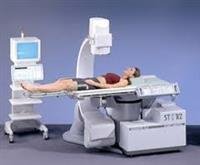
And here it will be more useful to use the shock wave device. It is a device that was developed in multiple stages, starting from the eighties, and after that it went through several stages of progress and development, among its advantages:
Accuracy in correction, small size, low pain perception of the patient, as for the way it works, it works to break the stones into very small particles so that the patient can then excrete them through the urine. This technique is used for stones as small as 1-2 cm in the kidney or above the ureter.
And the break-up process is in several separate sessions every week or two, and the session lasts
30 minutes, and before that the patient is given some sedatives and analgesics so that he does not feel any pain.
This technique is considered very safe and does not have any serious complications.
Third, Ureteroscopy.
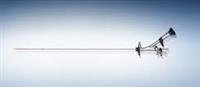
It is used to treat the middle and lower ureteral stones, by ing the endoscope from the urinary orifice into the bladder and then the ureter, and then the stone is broken up by laser and extracted completely, and a temporary ureter stent is placed for the patient.
Fourth, the flexible kidney and ureteroscopy.
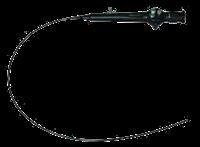
In this case, a longer endoscope is used than a regular endoscope and it is very flexible as it helps to move and reach the top of the ureter and to all sites in the kidney, and after that the stones are crushed by laser and extracted.
Fifth, nephoscopy through the back.
This very advanced technique is used for large kidney stones of 2 cm and larger, where a small incision is made through the back and the incision is expanded with a balloon, then directly into the kidney, and after that, we can break up the stones (hydraulically), extract them, and put a temporary tube in the kidney for two days.
This method helped us to avoid the incision operations, which take longer and the patient suffers more pain, and the patient does not need a long recovery period during which he is used to open operations.
Sixth, laparoscopy and robotic surgeries.
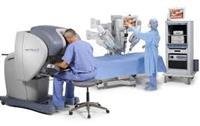
It is often a very large stone extraction. It is complex and complex or formed by the presence of congenital defects that do not respond to the other methods mentioned.
With regards to Dr. Ahmed Jalal Al-Sayyad
Urology consultant.